...that always reflect BACKWARDS in the mirror.

Rene Magritte, "Not to be Reproduced" (1937)
Paintings are the representations of the subjects from the perspective of the artist. What we believe we are seeing may or may not be the truth as the artist intended.
And that is not a bad thing – the ambiguity is what envelops paintings with mystery, allowing your imagination to kick in.
I believe this point is critical in understanding Magritte’s painting.
Not to Be Reproduced confronts us with two opposing realities: the incorrect reflection of the man vs. the correct reflection of the book. The painting is disquieting because it fails to meet our expectation to see the face and frontal body of the man in the mirror.
With this incongruity, Magritte is calling on our capacity of contemplation and imagination. He does not want the viewers to simply look at the painting and appreciate it as it is (which we probably would, had Magritte painted an accurate reflection of the man). Instead, he wants us to reflect on the contrasting realities, and experience the mystery that the painting evokes.
By painting a reproduction of the man’s back (as opposed to a reflection) we are also forced to question what we see, to question the reality of the narrative.
This has very much to do with the idea of the unreliable narrator.
Every work of art displays a subject in terms of how the artist envisions that subject. By introducing fictional physics (the impossible reflection of the man), Magritte incorporates an unreliable narrative into this painting.
The French copy of Edgar Allan Poe’s novel The Narrative of Arthur Gordon Pym of Nantucket that stands on the mantelpiece is very pertinent to this aspect of an unreliable narrative.
The protagonist of the novel, Arthur Gordon Pym, is a prototypical unreliable narrator (click here for our analysis of Poe’s novel). Pym’s narration contains contradictions, dubious events and even a confession from him that he may be fabricating some parts of his account
Zero Point Energy + Zero Point Time (the Present) = Consciousness on the Edge of the Dirac Sea?
Trapped Inside the Tesseract
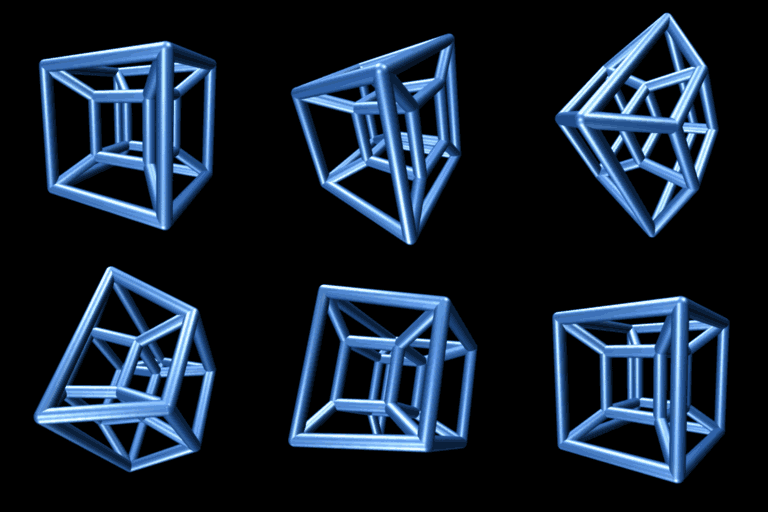
But Which Direction in Time is it Moving...
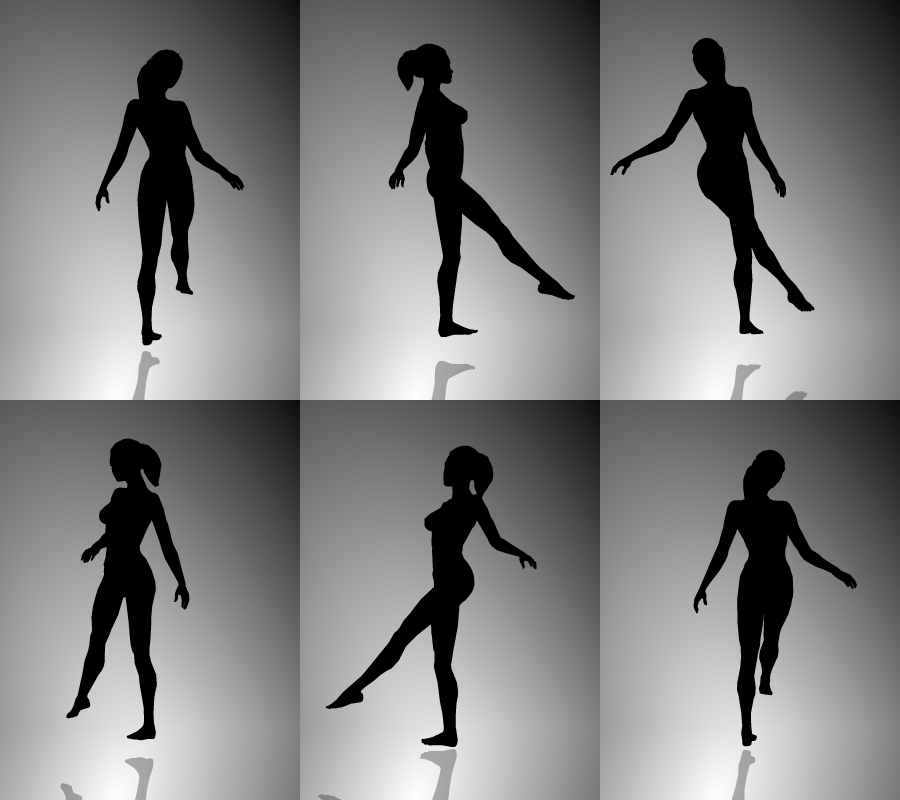
...To the Perspective of the Observer, or that of the Artist?
Time's Chirality Gets Trapped in Structure, Breaking the Mirror When it Emerges from the ZPE Dirac Sea, but Achiral Up Until Then?
No comments:
Post a Comment