Nothing exists on its own
Physicists have long known that quantum objects behave nothing like the solid, independent things of everyday experience. But the implications run deeper than strange behaviour. Carlo Rovelli's Relational Quantum Mechanics suggests that quantum systems have observer-dependent properties—what they are depends on their interactions with other systems. Drawing on a tradition running from Hume to contemporary metaphysics, philosopher Andrea Oldofredi explores this novel relational perspective on our world, arguing that objects are not the fundamental furniture of reality.
Quantum Mechanics is arguably one of the most successful theories in the history of science, for its predictions are confirmed by countless experiments, making it a cornerstone of contemporary physics. However, a century after its inception, the theory still challenges our classical worldview, offering a counterintuitive description of nature at microscopic scales. Contrary to classical mechanics, where objects are individually distinguishable and possess well-defined attributes at all times, QM speaks about indistinguishable systems with indeterminate properties, superposed states, and non-local interactions. Unsurprisingly, then, questions concerning its ontology, i.e., what fundamentally exists, are still vividly discussed to this day.
Despite its empirical success, however, physicists and philosophers alike enquire whether QM should be considered a true description of the natural world, because this theory is affected by conceptual conundrums and formal difficulties (e.g., the measurement problem). To address such issues, new quantum interpretations emerged from the 1950s. Among the many existing alternatives, here we consider a widely discussed framework that turns thirty this year, Carlo Rovelli’s Relational Quantum Mechanics (RQM).
RQM is motivated by Rovelli’s work in loop quantum gravity, where spacetime is not a substance existing per se, but rather it emerges from a dynamic network of relations, providing a relational perspective of it.
A new ontology for RQM
Now, with MBT in mind, let us introduce a new way to conceive objects in RQM. According to Rovelli, a physical system can be characterized “by a family of yes/no questions that can be meaningfully asked of it”, where such questions are measurements that can be performed on physical observables, i.e., properties, attributable to the system under consideration. An observer O may ask a set of potentially infinite questions Q1, Q2, …, Qn to the system s, obtaining the string(e1, e2, …, en) (1)
where each ei;represents a specific answer. Nonetheless, RQM postulates that “there is a maximum amount of relevant information that can be extracted from a system”. Hence, Rovelli says, a complete description of a physical system s is given in terms of the string[e1, e2, …, ek] (2)
with k < n , which is a subset of (1). Because in RQM information about systems is obtained through interactions, and questions are measurements on the system s performed by some observer O, (2) contains O’s knowledge about s. Clearly, this string represents the description of s relative to O; indeed, another observer P may ascribe to s a different list of properties/values.
Since in RQM physical systems are defined via a specific set of observables, it is then reasonable to characterize them as mereological bundles of qualities. In this way, RQM can be provided with a property-oriented ontology in which objects are defined straightforwardly, for in MBT they are reduced to properties. However, given that the values of the properties of quantum systems in Rovelli’s theory are observer-dependent, we can define the objects of RQM as mereological bundles of properties whose values depend on the perspective from which they are observed.
More precisely, one should say that there is a set of inherent properties characterizing a certain species of particles—such as mass, charge, spin, etc.—which are not observer-dependent, so that their value remains constant. On the contrary, the values of extrinsic properties (such as energy, position, momentum, etc.) are observer-dependent and change relative to specific observers. Additionally, in virtue of contextuality and the algebraic structure of QM, not all observables associated with a certain system can have definite values.
To give an example, in RQM, an electron is characterized by inherent properties such as mass, charge, and spin-1/2, and extrinsic properties such as momentum, energy, angular momentum, and position. These latter have relational and contextual values which depend on the specific interactions of the particle under consideration with different observers.
Conclusion
Elaborating on Paul’s MBT, we saw in this piece that RQM is compatible with an ontology of properties. This fact has interesting consequences, since it shows that quantum objects need neither be thought of as bare particulars nor as Aristotelian substances. On the contrary, following Hume’s tradition, we can define them as bundles of qualities, where intrinsic properties characterizing a certain species of particles have constant values, extrinsic qualities take definite values relative to particular observers, and not every observable defining a system can have a definite value in virtue of the quantum formalism. Additionally, from our perspective on RQM, we can properly speak about material objects in motion and interacting in spacetime. Hence, we can enrich and clarify its event ontology, making it a full-fledged realist interpretation of quantum theory.
Let’s step back from the technical details for a moment and consider what this picture is really telling us. We live our lives taking for granted that objects exist. This seems an obvious fact. The chair you are sitting on, the phone in your hand, the body you inhabit, the most solid and unquestionable features of reality. But what Rovelli’s quantum mechanics suggests is that this intuition, while practically indispensable, is not the deepest truth about our world. Underneath the solid, stable objects of everyday experience, there is no hidden substance giving things their identity and independence. There are only properties, interactions, and the relational facts that such interactions generate. What we call an object is not a “thing in itself,” but a bundle of properties that holds together reliably enough at the scales we inhabit to function as a thing. But zoom in far enough, and the thing dissolves into its relationships and qualities.
Thursday, May 28, 2026
Reality's Quantum Image-Generating Framework
Wednesday, May 27, 2026
From NEETS to Hikikomori to Cloud-Serfs...
NEET is an acronym that stands for Not in Education, Employment, or Training. It is a socioeconomic classification that refers to young adults or teenagers who are unemployed and not enrolled in school or vocational training.
The Social and Economic Phenomenon
Originally coined in the United Kingdom in the late 1990s, the term has become a widely used metric for economists and sociologists globally to track the health of youth labor markets.
The Classification: It applies to individuals, typically between the ages of 16 and 24, who are either actively looking for work or have stopped participating in the labor force entirely.
Global Scope:Other Meanings
- The phenomenon exists globally, with higher percentages often exacerbated by complex factors such as mental health struggles, caregiving responsibilities, or difficulties transitioning from school to work.
- Cultural Slang: In internet culture and some countries like Japan, the term can sometimes be colloquially used to describe individuals who intentionally retreat from society, often spending their time at home.
If you are not referring to the socioeconomic acronym, you might be thinking of the National Eligibility cum Entrance Test (NEET). This is a massive, highly competitive medical entrance examination in India required for students seeking admission to undergraduate medical and dental programs.
Sunday, May 24, 2026
Avoiding Civilizational Collapse - 3 Strategies
If man wants to progress, he must create new forms of energy of greater and greater densities.
-Lazare Carnot (1784)
Hands Up! Georges Bataille: The Threadless Minotaur Living Inside Goedel's Labyrinth
Heidegger's hand is tied to the terrestrial order. Thus, it does not grasp the human future. Human beings have long since stopped dwelling between 'earth' and 'sky'. On the way towards the un-thinged [Unbedingtheit], they will also leave the 'mortals' and the 'divinities' behind. The last things (τὰ ἔσχατα) will also have to be eliminated. Human beings soar up towards the un-thinged, the unconditioned. We are headed towards a trans-human and post-human age in which human life will be a pure exchange of information. Human beings shed their being be-thinged, their facticity, even though this is precisely what makes them what they are. 'Human' is derived from humus, that is, soil. Digitalization is a resolute step along the way towards the abolition Of the humanum. The future Of humans seems mapped out: humans will abolish themselves in order to posit themselves as the absolute .Byung-Chul Han, "Heidegger's Hand"
Ipseity is the quintessential element of identity, derived from the Latin word ipse (meaning "self"). It refers to selfhood, individuality, or the unique quality and nature of being yourself.
Where You'll Encounter the Word
- Philosophy: Used in phenomenology and existentialism to describe the first-person perspective, "mineness," or the foundation of human consciousness.
- Psychology: "Ipseity disturbance" (or self-disorder) is a term used to describe a foundational rupture in an individual's sense of existing as a distinct subject.
- Theology: Often contrasted with aseity (existing entirely of and from oneself)
Saturday, May 23, 2026
Emile Durkheim: Sociology, Suicide, and the Nature of Religion
Friday, May 22, 2026
Marcel Mauss: A Century of Symbolic Gift Giving
The twin towers were not destroyed by terrorists. The twin towers committed suicide. They collapsed under their own weight. When the two towers collapsed, you had the impression that they were responding to the suicide of the suicide planes with their own suicide. It has been said that even God cannot declare war on himself. Well he can. The West in the position of God, divine omnipotence and absolute moral legitimacy has become suicidal and declared war on itself.
-Jean Baudrillard, "The Spirit of Terrorism"
from Google AI:
Continental Philosophy (The Event as Rupture)
- Alain Badiou: A French philosopher who defines an event as an unpredictable, ground-breaking rupture that brings forth new truths. According to Badiou, an event shatters established norms and forces individuals to take a leap of faith to remain faithful to this new truth (e.g., a revolutionary political movement or falling in love).
- Gilles Deleuze: Drawing from the ancient Stoics, Deleuze viewed events as "incorporeal" entities. Rather than physical actions, events are the meaning or sense of what happens, which subsist at the surface of things and transform how we understand ourselves and our realities.
- Martin Heidegger: In his later work (Contributions to Philosophy), Heidegger conceptualizes the event (or Ereignis) as a moment of appropriation, where human beings and the meaning of "Being" come into a mutually revealing relationship.
The End of Pure Positivity
Thursday, May 21, 2026
Wednesday, May 20, 2026
Valentin Turchin: Meta-Systems Transition Theory - A Case for Anti-Fragility?
Chapters:
00:00 The night the bronze age went silent07:10 The world before the crash15:00 Egypt’s records and the sea peoples name23:36 The last letters from ugarit36:55 Hatti collapses and hattusa burns51:34 Mycenaean greece and the end of palace life1:08:45 Cities along the levantine coast fall1:24:18 Cyprus and the broken copper highway1:39:51 Anatolia in motion1:54:27 What the battles might have looked like2:08:15 Earthquakes, drought, and the climate question2:22:22 Piracy, refugees, and a sea full of desperation2:36:14 Why the great powers couldn’t bounce back2:50:30 Where did the mystery army go3:03:39 What the collapse left behind3:19:32 A mystery that still breathes
What? No "Sea Peoples" from Atlantis?
Tuesday, May 19, 2026
Monday, May 18, 2026
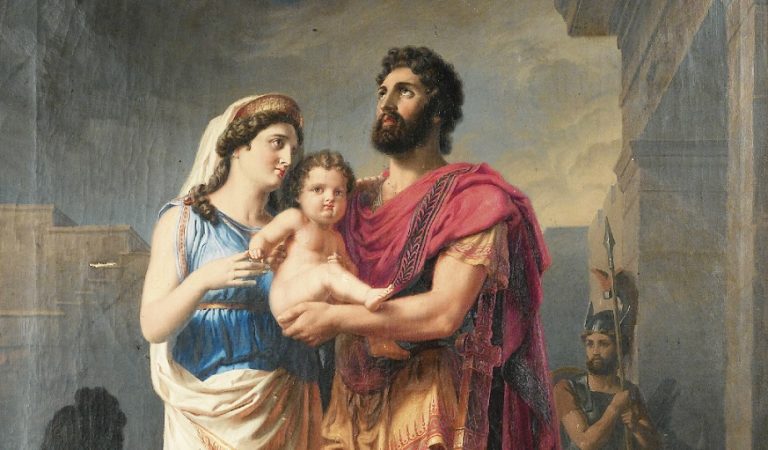
Hector Goes to War
Andromache
Will you, my Hector, forever go away
to where with unmatched hands Achilles makes
Patroclus bloody off’rings?
____________________Who will teach
your little one with strength to throw the spear,
or how to honor the gods, if what I fear
occurs and Orcus devours you?
Hector
Dear wife, enough of tears, for go I must,
for love of you I burn with battle-lust
my arms sustain Pergamus.
____________________If now I fall,
I’ll fall in the Trojan gods’ and your defense
as a pious hero, then make my descent
to grim, to Stygian Dis.
Andromache
I’ll never hear the clash of your weapons again,
unused, your iron will rust in the halls of men,
and Priam’s line will die.
__________________You’ll go to where
no sun, no day e’er shines his golden face,
to where the Cocytus slithers through the waste,
your love will die in the Lethe.
Hector
Though all my hopes and all my thoughts will sink,
from the gentle flow of the Lethe, my love won’t drink,
no, my love won’t drink.
__________________Listen! The Greeks
are blustering at Ilium’s walls. Now gird my sword,
hold back your tears, and listen to my word;
My love won’t die in the Lethe.
Georges Bataille: The Solar Anus & Sovereignty
THE PLAN
In the beginning was The Plan.
And then came the assumptions.
And the assumptions were without merit.
And The Plan was without substance.
And darkness was upon the face of the workers.
And they spoke among themselves, saying, “It is
a crock of shit, and it stinketh.”
And the workers went unto their supervisors and said,
“It is a pail of dung, and none may abide the odor thereof.”
And the supervisors went unto their managers, saying, “It is
a container of excrement and it is very strong, such that
none may abide by it.”
And the managers went unto their directors, saying,
“It contains that which aids plant growth, and it is very strong.”
And the directors went unto the VPs, saying unto them,
“It promotes growth and it is very powerful.”
And the VPs went unto the Prez, saying unto him, “This plan
will actively promote the growth and vigor of the company,
with powerful effects.”
And the Prez looked upon the plan, and saw that it was good.
And The Plan became Policy.
This is how shit happens!
Sunday, May 17, 2026
On Lamaism vs. Islam: Where to Invest a Society's Surplus?
Life is a chemical System that uses energy to keep itself from reaching chemical equilibrium. Equilibrium is the situation in which chemicals no longer have a tendency to react over time.
What are a Society's Eschatological Goals for the End Times. To Immanentize it, or to Catechize it? And to serving and achieving what 'ends' should a Society devote its' Surplus (Luxury - Necessity) energies?
While Marx seeks to understand and optimize the production of wealth through human effort [Anthropogenic Energy?}. Bataille seeks to understand the necessary destruction of wealth through energy expenditure [Energy in all its' forms?].
Friday, May 15, 2026
Are you on Kronos Time? Or Kairos Time?
Portia: I pray you tarry, pause a day or twoBefore you hazard, for in choosing wrong
I lose your company; therefore forbear a while.
There’s something tells me (but it is not love)
I would not lose you, and you know yourself
Hate counsels not in such a quality.
But lest you should not understand me well
(And yet a maiden hath no tongue but thought)
I would detain you here some month or two
Before you venture for me. I could teach you
How to choose right, but then I am forsworn.
So will I never be. So may you miss me.
But if you do, you’ll make me wish a sin,
That I had been forsworn. Beshrew your eyes,
They have o’erlooked me and divided me.
One half of me is yours, the other half yours—
Mine own, I would say—but if mine, then yours,
And so all yours. O, these naughty times
Puts bars between the owners and their rights!
And so though yours, not yours. Prove it so,
Let Fortune go to hell for it, not I.
I speak too long, but ’tis to peize the time,
To eche it, and to draw it out in length,
To stay you from election.
from Google AI:
Spoken by Portia in Shakespeare's The Merchant of Venice, "peize the time, to eche it" refers to intentionally slowing or extending time to delay a critical moment. The phrase combines weighing down the pace with stretching it out, illustrating her desire to postpone Bassanio's casket choice.
Not all decisions must be made at the Speed of Causality!? ;)
Wednesday, May 13, 2026
Hans-Georg Moeller: The Dark Psychology behind the West's Anti-Universalist "Affirmative-Semitism"
“There is no such thing as collective guilt or collective innocence; guilt and innocence make sense only if applied to individuals.”–Hannah Arendt, "Personal Responsibility Under Dictatorship"
Tuesday, May 12, 2026
Tuesday, May 5, 2026
Positive Geometries, not Space-Time, is Fundamental?
Positive geometry is an interdisciplinary field linking theoretical physics and algebraic geometry, where physical observables—such as particle scattering amplitudes—are determined by the geometry of specific shapes. These "positive geometries," including amplituhedra and cosmological polytopes, are specialized, often convex, higher-dimensional shapes that encode scattering probabilities and cosmological interactions through their structural boundaries and a unique associated "canonical form".
Key Aspects of Positive Geometry:
- Fundamental Idea: It provides a new way to calculate particle scattering amplitudes and cosmological correlations, bypassing traditional Feynman diagram methods.
- The Amplituhedron: Considered a prototypical positive geometry, it lives in momentum twistor space and helps calculate scattering in planar N=4 supersymmetric Yang–Mills theory.
- Structure: They are defined as semi-algebraic subsets of complex projective varieties (over the real numbers), with boundaries corresponding to physical singularities (where particle processes diverge).
- Canonical Form: Each positive geometry is associated with a unique "canonical form"—a differential form with logarithmic singularities on all boundaries.
- Significance: It serves as a candidate to redefine the foundations of quantum field theory and gravity, potentially showing that spacetime locality and unitarity are emergent properties rather than foundational assumptions.
Positive geometry connects the abstract mathematics of convex polytopes and complex varieties to the practical calculation of particle interaction rates and cosmological evolution.
“we must abandon the project of reconciling spacetime and quantum mechanics, and accept that spacetime, at least as Einstein described it, does not exist.”https://t.co/Pe73C4GgbT
— Donald Hoffman (@donalddhoffman) April 21, 2026
Yes, in the context of theoretical biology and cognitive science (specifically the Free Energy Principle), identity is often conceptualized as a Markov blanket. It acts as the boundary or interface that separates an agent's internal states from the external environment, defining what is "self" versus "not-self".Here is a breakdown of the connection:
- Definition of Self: A Markov blanket separates internal states (e.g., brain activity, metabolic states) from external states (e.g., the world). Your sense of self emerges within this blanket.
- Boundary Function: The blanket consists of sensory and active states that mediate interactions between the internal and external world. It defines an "inside" and "outside".
- Active Inference: As described in this Medium article by Satyam and thisLessWrong post, active inference is how systems maintain their identity (Markov blanket) by managing sensory input and active outputs, as explored in this PMC article.
- Dynamic Identity: Identity is not static; rather, it is a process of "knitting" a Markov blanket, meaning that living creatures actively maintain their boundaries through autopoietic (self-producing) processes.
- Scale Invariance: Markov blankets are nested, which means that "identities" can exist at different scales—from a single cell's membrane to an organism's sensorium.
While a Reddit thread provides an intuitive overview of the concept, the idea that Markov blankets are essential for biological self-organization is detailed further in this research paper.
Monday, May 4, 2026
Entanglement is Geometry...(ER=EPR)
"To Be, or Not to Be? THAT is the Question!"
"The only thing we can truly change is the meaning of things."
-Alain Badiou
Transforming the Master Discourse into a University (Moralizing) Discourse: "Why this is the Good/ Right/ Best/ ONLY Way to Do It Properly...."
Sunday, May 3, 2026
When the University Discourse Becomes a Mass Formation Psychosis
Gustave Le Bon in the 19th century century already wrote in his book "The Psychology of the Crowd" he said like, "the higher the level of education, the more people will fall prey to mass formation."
00:00:00 Introduction 00:00:50 Mass formation and totalitarianism 00:10:02 Totalitarianism vs dictatorship 00:18:18 War narratives and media power 00:20:30 Education propaganda and democracy 00:32:18 Mechanics of mass formation 00:43:40 Breaking the spell with sincerity 00:50:40 Truth reality and the observer 00:57:42 Final thoughts and where to follow