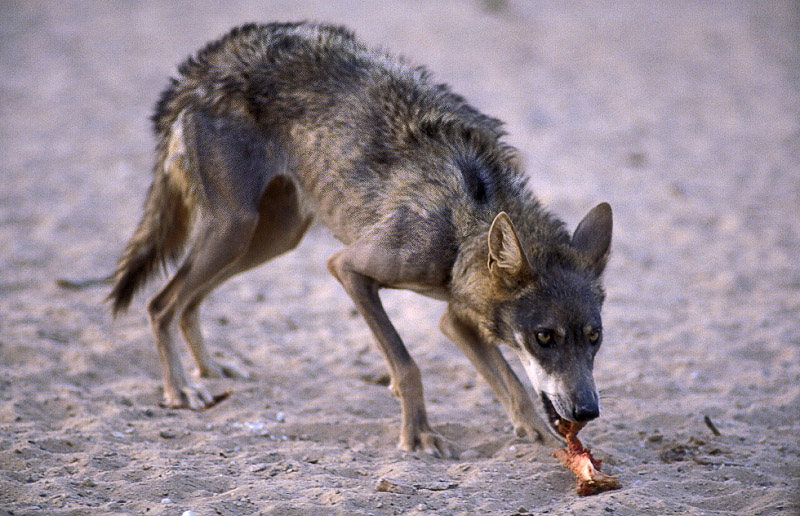
Of course, there are Oedipal statements. For example, Kafka's story, "Jackals and Arabs"), is easy to read in that way: you can always do it, you can't lose, it works every time, even if you understand nothing. The Arabs are clearly associated with the father and the jackals with the mother; between the two, there is the whole story of castration represented by the rusty scissors. But is so happens that the Arabs are an extensive, armed, organized mass stretching across the entire desert; and the jackals are an intensive pack forever launching into the desert following lines of flight and deterritorialization ("they are madmen, veritable madmen"); between the two, at the edge, the Man of the North, the jackal-man. And aren't those big scissors the Arab sign that guides or releases the jackal particles, both to accelerate their mad race by detaching them from the mass, and to bring them back to the mass, to tame them and whip them, to bring them around? Dead camel: Oedipal food apparatus. Counter-Oedipal carrion apparatus: kill animals to eat, or eat to clean up carrion. The jackals formulate the problem well: it is not that of castration but of "cleanliness" (proprete, also "ownness"), the test of desert-desire. Which will prevail, mass territoriality or pack deterritorialization? The libido suffuses the entire desert, the body without organs on which the drama is played out.- Deleuze and Guattari, "A Thousand Plateaus"
