Saturday, January 14, 2023

Thursday, January 12, 2023
America and the Rise of Cultural Cannibalism
Jeju Uprising and Massacre
 From the Zizek video above:
The Jeju uprising, known in South Korea as the Jeju April 3 incident (Korean: 제주 4·3 사건), was an uprising on Jeju Island from April 1948 to May 1949. Residents of Jeju opposed to the division of Korea had protested and had been on a general strike since 1947 against elections scheduled by the United Nations Temporary Commission on Korea (UNTCOK) to be held only in the territory controlled by the United States Army Military Government in Korea. The Workers' Party of South Korea (WPSK) and its supporters launched an insurgency in April 1948, attacking the police, and Northwest Youth League members stationed on Jeju mobilized to violently suppress the protests: 166–167 The First Republic of Korea under President Syngman Rhee escalated the suppression of the uprising from August 1948, declaring martial law in November and beginning an "eradication campaign" against rebel forces in the rural areas of Jeju in March 1949, defeating them within two months. Many rebel veterans and suspected sympathizers were later killed upon the outbreak of the Korean War in June 1950, and the existence of the Jeju uprising was officially censored and repressed in South Korea for several decades: 41
The Jeju uprising was notable for its extreme violence; between 14,000 and 30,000 people (10 percent of Jeju's population) were killed, and 40,000 fled to Japan: 139, 193 Atrocities and war crimes were committed by both sides, but historians have noted that the methods used by the South Korean government to suppress protesters and rebels were especially cruel, with violence against civilians by pro-government forces contributing to the Yeosu-Suncheon rebellion in South Jeolla during the conflict: 171: 13–14: 186 Some historians and scholars, including military historian Allan R. Millett, regard the Jeju uprising as the true beginning of the Korean War.
In 2006, almost 60 years after the Jeju uprising, the South Korean government apologized for its role in the killings and promised reparations. In 2019, the South Korean police and defense ministry apologized for the first time over the massacres.

Did you notice that all, from the early modernity on, ALL leaders, since from modernity on cannot any longer rely unproblematically on some transcended source of authority... i.e.- "I'm a king because God invested in me my Authority" or "because of some higher Destiny my sacred Origins legitimately..." so the logical solution is that leaders, themselves Masters, proclaim themselves servants? Like Friedrich the Great the famous German person, Prussian King, who called himself the servant of State? And there are, of course, different modalities of this position of "serving the servants" from technocracy experts, who say "We just serve Society, we don't have any interest", to religious fundamentalism, to a new figure of obscene Master's clowns like Donald Trump.
The obscene Master is not a direct reaction to the failure of the traditional Master. This figure is a reaction to the fact that expert knowledge, pure technocracy, cannot properly function. It has to be supplemented by the new figure of a Master.
How should we react to this situation? The first, now I will try to be as short as possible, the first version is it's the most tragic version for me it's cynicism. It's that we reluctantly accept the need to return to some form of social Authority but we say "just act as if you accept it, pretend that you accept it play the game... don't accept it seriously."
Tuesday, January 10, 2023
On the New Art for the Masses and Blending of Low/ High Cultures (Walter Benjamin)
....Ease of Mechanical Reproduction Moves Art out of the Sphere of Authenticity of the "original" and thereby Murders the Aura of 'Ritual'. The audience becomes "democratized" through "copies" and every "lay" viewer is elevated through the "director's camerawork" to status of 'expert". The mass viewing experience becomes socialized through the socialization of the media (display in the theatre), and visa versa, the individual also socially conditioned to react in anticipation of a group social/ mass reaction.
It shifts the "cult value" of an Art form into an "exhibition value" in new media and thereby transforms "authenticity" into "profile-ism", imposing an "exhibition anxiety" upon the participatory mass audience members that leads to Byung-Chul Han's Burn-out Society under capitalism.
Sunday, January 8, 2023
Saturday, January 7, 2023
Yes We Can Byung-Chul Han! On the Virtues of Boredom.
Alessandro Sbordoni, "Semiotics of the End: Boredom at the End of the World"
Dreams about the end of the world are not, perhaps, anymore the fruits of despair and fear alone. They are also the frolics of boredom.
It is not only when the world is evil or ugly, but when it does not matter anymore whether the world exists or not that feverish dreams of destruction surge from the depths; it is amidst yawns, more often than whimpers and cries, that the world ends.
A friend once told me: ‘When I am bored, I would like to watch the world burn.’ The world thus ends, and it is just fantasy. That is because boredom does not really destroy anything, it does not create at all.
The paradox of boredom
As Byung-Chul Han writes in The Burnout Society, “deep boredom is the peak of mental relaxation. A purely hectic rush produces nothing new. It reproduces and accelerates what is already available” (p. 13). Boredom is pure repetition, reproduction without finality. If boredom does in fact produce dreams of the end, it is because the end turns out to have become impossible.
Everything is a copy. All days resemble each other. Week after week, it all repeats again. Then, a thought of creation or destruction. Boredom is thus eliminated; nothingness neutralizes mere repetition. A principle of nothingness is indeed necessary to both creation and destruction; it is when the temptation of nothingness overcomes the dullness of the here-and-now that creating and destroying become possible. Boredom then, since nothing new has been generated, repeats itself.
Dreams of the end
A new sort of nihilism is arising from the boredom that describes late capitalism. It is the nihilism according to which the end has lost its finality.
In a post from January 13, 2007, Mark Fisher argues that “we have ceased to imagine the end of the world just as surely as we have lost our ability to imagine the end of capitalism. Oddly, apocalyptic dread – so omnipresent during the Cold War – seems to have been extirpated from the popular unconscious. […] If it is increasingly difficult to imagine alternatives to capitalism, that is because the world has already ended.”
Disaster movies do not anymore appeal to feelings of fear or anxiety about the future. Instead, they aim at the elimination of boredom, successfully achieved through hyperstimulation. Films such as Sharknado (2013) or Godzilla vs Kong (2021) are for children what pornography is for adults.
Dreams of the end are over. And it is not because of cynicism, but because of deep boredom: nothing is possible, because nothing is impossible anymore.
The dreams of the end told by disaster “porn” movies represent the ultimate simulacrum. Representations of their own nothingness. Nihilism of the end.
“The apocalypse is finished, today it is the precession of the neutral, of forms of the neutral and of indifference” (p. 160) wrote Jean Baudrillard in 1981’s Simulacra and Simulation. Forty years after the end, it is the apocalypse of the boring: the triumph of hyperstimulation, digital recombination, pure repetition without difference. And as the thought of the end has been neutralized, with it, the seduction of images perishes. It is the land of boredom. The yawn and the abyss.
Hypernothingness
The solution to the paradox of boredom is hypernothingness: nothingness that is more than creation and destruction, reality and simulation. If dreams of the end today still depend on reality and representation, in the realm of hypernothingness the end is both possible and impossible.
The screen is black. There is no sound except for the whispering of the wind. As the film The Turin Horse (2011) is about to reach its conclusion, it is as if the world and the screen both disappear. Another nothingness then enters the dream. Absolute difference is thus introduced within nothingness itself. It is the representation of a new nothingness, which neither creates nor destructs. Instead, it returns dream to sleep.
And yet, hypernothingness does not restore reality nor its nihilistic negation. Rather, it abolishes the difference between the real and the hyperreal, boredom and its eschaton.
It is the realization of boredom at the end of the world.
0, or the sound of the end
The music industry is another apt example of the paradox of boredom and the nihilism of the end.
Once more, it is not hard to discover a pornographic approach to the imaginary of the end. “Sicker than the remix / Baby, let me blow your mind tonight,” then the chorus: “I can’t take it, take it, take no more / Never felt like, felt like this before / Come on get me get me on the floor.” This extract from Britney Spears’ lyrics of Till the World Ends (2011) follows a narrative of the end as consumerism without purpose, without finality. It is the catastrophe of meaning, where the end itself has become impossible since hyperstimulation and repetition have divested the end of its reality.
The future is no longer possible. The future does not exist if not as the simulacra of consumption, hence the pornographies of desire.
Today the future does not exist anymore if not as the reconfiguration of the past; ghosts of the past haunt the present via remixes, sequels, and remakes. The new almost does not mean anything anymore. Hyperstimulation and repetition already remove the possibility of the end. The paradox of boredom repostulates itself as long as nothing is created nor destructed. It is pure repetition without difference; the nothingness of the simulacra.
Again, the palliative against the nihilism of this culture of the end is hypernothingness.
A one-minute-long silence predates the end of The Caretaker’s album series Everywhere at the End of Time (2016–2019), partly dedicated to the memory of Mark Fisher, who disappeared in 2017. “The inability to distinguish the present from the past” (Mark Fisher’s words about The Caretaker’s sound-theory), produced by the remix and disfiguration of recordings from a long-forgotten past, now leaves space to hypernothingness.
But hypernothingness does not simply signify the end: it creates the end. In it, plenitude is abolished. The melancholia and nostalgia describing the recording fade away at last. Throughout this minute of hypernothingness, indifference is slowly converted into the atmosphere of the end itself.
There are no more sounds but wafts of nothingness.
The simulation of silence, rather than drawing the music to a close, further opens up a space for sleep and the ataraxy of the end. Boredom at the end of time. The hypernothingness of silence abolishes the difference between the representation of nothingness and nothingness itself, between deep listening and deep boredom.
Is it the sound of the end?
REFERENCESBaudrillard, J. (1994). Simulacra and Simulation (Trans. S. F. Glaser). Ann Arbor: The University of Michigan Press. (Original work published 1981).
Britney Spears (2011). Till the World Ends [Song recorded by Britney Spears]. On Femme Fatale. Jive. http://www.youtube.com/watch?v=qzU9OrZlKb8
Ferrante, A. C. (Director). (2013). Sharknado [Film]. Syfy Films.
Fisher, M. (2007, January 13). The Damage is Done. k-punk. http://k-punk.abstractdynamics.org/archives/2007_01.html
Fisher, M. (2008, May 13). No Future 2012. k-punk. http://k-punk.abstractdynamics.org/archives/010368.html
Han, B.-C. (2015). The Burnout Society (Trans. E. Butler). Stanford: Stanford University Press. (Original work published 2010).
Tarr, B., & Hranitzky, Á. (Directors). (2011). The Turin Horse [Film]. T. T. Filmműhely.
The Caretaker (2016–2019). Everywhere at the End of Time [Album series]. History Always Favours the Winners. http://thecaretaker.bandcamp.com/album/everywhere-at-the-end-of-time
Wingard, A. (Director). (2021). Godzilla vs Kong [Film]. Legendary Pictures

Merry Orthodox Christmas?!
Many Orthodox Christians annually celebrate Christmas Day on or near January 7 to remember Jesus Christ’s birth, described in the Christian Bible. This date works to the Julian calendar that pre-dates the Gregorian calendar, which is commonly observed.
Thursday, January 5, 2023
Normal Science Dominance... Has it Now Become Punitive, Also, to "Protect the Paradigm's Bureaucracy?" If so, It's no longer "Science", it's "Dogma".

Max Kozlov, "‘Disruptive’ science has declined — and no one knows why"
The proportion of publications that send a field in a new direction has plummeted over the last half-century.
The number of science and technology research papers published has skyrocketed over the past few decades — but the ‘disruptiveness’ of those papers has dropped, according to an analysis of how radically papers depart from the previous literature1.
Data from millions of manuscripts show that, compared with the mid-twentieth century, research done in the 2000s was much more likely to incrementally push science forward than to veer off in a new direction and render previous work obsolete. Analysis of patents from 1976 to 2010 showed the same trend.
“The data suggest something is changing,” says Russell Funk, a sociologist at the University of Minnesota in Minneapolis and a co-author of the analysis, which was published on 4 January in Nature. “You don’t have quite the same intensity of breakthrough discoveries you once had.”
Telltale citations
The authors reasoned that if a study was highly disruptive, subsequent research would be less likely to cite the study’s references, and instead cite the study itself. Using the citation data from 45 million manuscripts and 3.9 million patents, the researchers calculated a measure of disruptiveness, called the ‘CD index’, in which values ranged from –1 for the least disruptive work to 1 for the most disruptive.
The average CD index declined by more than 90% between 1945 and 2010 for research manuscripts (see ‘Disruptive science dwindles’), and by more than 78% from 1980 to 2010 for patents. Disruptiveness declined in all of the analysed research fields and patent types, even when factoring in potential differences in factors such as citation practices.
The authors also analysed the most common verbs used in manuscripts and found that whereas research in the 1950s was more likely to use words evoking creation or discovery such as, ‘produce’ or ‘determine’, that done in the 2010s was more likely to refer to incremental progress, using terms such as ‘improve’ or ‘enhance’.
“It’s great to see this [phenomenon] documented in such a meticulous manner,” says Dashun Wang, a computational social scientist at Northwestern University in Evanston, Illinois, who studies disruptiveness in science. “They look at this in 100 different ways, and I find it very convincing overall.”
Other research2 has suggested that scientific innovation has slowed in recent decades, too, says Yian Yin, also a computational social scientist at Northwestern. But this study offers a “new start to a data-driven way to investigate how science changes”, he adds.
Disruptiveness is not inherently good, and incremental science is not necessarily bad, says Wang. The first direct observation of gravitational waves, for example, was both revolutionary and the product of incremental science, he says.
The ideal is a healthy mix of incremental and disruptive research, says John Walsh, a specialist in science and technology policy at the Georgia Institute of Technology in Atlanta. “In a world where we’re concerned with the validity of findings, it might be a good thing to have more replication and reproduction,” he says.
Why the slide?
It is important to understand the reasons for the drastic changes, Walsh says. The trend might stem in part from changes in the scientific enterprise. For example, there are now many more researchers than in the 1940s, which has created a more competitive environment and raised the stakes to publish research and seek patents. That, in turn, has changed the incentives for how researchers go about their work. Large research teams, for example, have become more common, and Wang and his colleagues have found3 that big teams are more likely to produce incremental than disruptive science.
Finding an explanation for the decline won’t be easy, Walsh says. Although the proportion of disruptive research dropped significantly between 1945 and 2010, the number of highly disruptive studies has remained about the same. The rate of decline is also puzzling: CD indices fell steeply from 1945 to 1970, then more gradually from the late 1990s to 2010. “Whatever explanation you have for disruptiveness dropping off, you need to also make sense of it levelling off” in the 2000s, he says.doi: https://doi.org/10.1038/d41586-022-04577-5
References
Park, M., Leahey, E. & Funk, R. J. Nature 613, 138–144 (2023).
Article
Google Scholar
Cowen, T. & Southwood, B. Preprint at SSRN http://doi.org/10.2139/ssrn.3822691 (2019).
Wu, L., Wang, D. & Evans, J. A. Nature 566, 378–382 (2019).


The Ontario College of Psychologists wants to retrain me to behave properly — and this should concern everyone
The practice of psychology in Ontario, and in many other North American and western jurisdictions, is subject to regulation by “professional colleges” — essentially governmental organizations with a mandate to protect the public from misconduct on the part of physicians, lawyers, social workers, dentists, pharmacists, teachers, architects and many others, including (and most relevant to me) clinical psychologists.
Anyone anywhere in the world can levy a complaint to these regulatory bodies for any reason, regardless of whether the complainant has had any direct contact with the professional in question. The respective colleges have the responsibility to determine whether each complaint is serious and credible enough to warrant further investigation. Complaints can be deemed vexatious or frivolous and dispensed with. When the college decides to move forward, it is a serious move, essentially equivalent to a lawsuit. The Ontario College of Psychologists in fact recommends legal counsel under such conditions.
The Ontario College of Psychologists has levied a multitude of such lawsuits against me since my rise to public prominence six years ago (although none at all in the 20 years or so I practised as a psychologist before that). These have multiplied as of late, and now number more than a dozen. This may seem like a lot (and “where there’s smoke there’s fire,” or so people think), but I might point out that it is difficult to communicate with as many people as I do and to say anything of substance without rubbing at least a few of them the wrong way now and then.
For my crimes, I have been sentenced to a course of mandatory social-media communication training with the college’s so-called experts (although social media communication training is not a scientific and certainly not a clinical specialty of any standing). I am to do this at my own expense (some hundreds of dollars per hour) and for a length of time that is to be determined only by those retraining me and profiting from doing so. How will this be determined? When those very re-educators — those experts — have convinced themselves that I have learned my lesson, and will behave properly in the future.If I agree to this, then I must admit that I have been unprofessional in my conduct, and to have that noted publicly, even as the college insists that I am not required to admit to any wrongdoing. If I refuse — and I have (of course) refused — the next step is a mandatory public disciplinary session/inquiry and the possible suspension of my clinical licence (all of which will be also announced publicly).It's worse than you think in Canada @elonmusk. Regulated professionals are now terrified into silence by their respective colleges. This means they are no longer able to say what they believe to be true. And who needs that from their lawyers, physicians -- or psychologists? https://t.co/sWvIPVHU0e
— Dr Jordan B Peterson (@jordanbpeterson) January 3, 2023
I should also point out that the steps already taken constitute the second most serious possible response to my transgressions on the part of the college. I have been placed in the category of repeat offender, with high risk of further repetition.
What exactly have I done that is so seriously unprofessional that I am now a danger not only to any new potential clients but to the public itself? It is hard to tell with some of the complaints (one involved the submission of the entire transcript of a three-hour discussion on the Joe Rogan podcast), but here are some examples that might produce some reasonable concern among Canadians who care about such niceties as freedom of belief, conscience and speech:
I retweeted a comment made by Conservative Leader Pierre Poilievre about the unnecessary severity of the COVID lockdowns;
I criticized Prime Minister Justin Trudeau;
I criticized Justin Trudeau’s former chief of staff, Gerald Butts;
I criticized an Ottawa city councillor; and
I made a joke about the prime minister of New Zealand, Jacinda Ardern.I did all that “disrespectfully,” by the way, in a “horrific” manner that spread “misinformation”; that was “threatening” and “harassing”; that was “embarrassing to the profession.” I am also (these are separate offences) sexist, transphobic, incapable of the requisite body positivity in relationship to morbid obesity and, unforgivably of all, a climate change denialist.
Every single one of these accusations (and now accepted evidence of my professional misconduct) is independent of my clinical practice — which, by the way, has been suspended since 2017, when my rising notoriety or fame made continuing as a private therapist practically and ethically impossible. Every single accusation is not only independent of my clinical practice, but explicitly political — and not only that: unidirectionally explicitly political. Every single thing I have been sentenced to correction for saying is insufficiently leftist, politically. I’m simply too classically liberal — or, even more unforgivably — conservative.
For criticizing our prime minister and his cronies and peers, for retweeting Pierre Poilievre, the leader of the official Opposition in Canada, and for holding and for daring to express reprehensible political views, I have now been convicted by the College of Psychologists of “harming” people in some manner serious enough to justify my forced re-education. Now that I have refused, I will definitely face further exceptionally public, demanding, time-consuming and expensive disciplinary action, including the suspension of my licence. This, despite the fact that none of the people whose complaints are being currently pursued were ever clients of mine, or even knew clients of mine, or even knew or were acquainted with any of the people they claim I am harming. This, despite the fact (and please attend to this) that half the people who levied such complaints falsely claimed that they had in fact been or currently are clients of mine.It may be of some interest to note that I wrote to Prime Minister Justin Trudeau this week, informing him of this situation. Here is the letter, for public consideration — which by necessity repeats some of what I have just covered in this introduction:To clarify: it's been decided: I either submit to social media communication retraining or face a disciplinary hearing and possible suspension of my clinical license and the right to represent myself as a psychologist @elonmusk @CPOntario https://t.co/qmsje8flyN
— Dr Jordan B Peterson (@jordanbpeterson) January 3, 2023Dear Prime Minister Trudeau:I thought it my duty to inform you and your office of the following proceedings against me.
The Ontario College of Psychologists, the provincial government-mandated and supported professional body charged with regulating the practice of clinical psychology, is requiring that I undergo a lengthy course of “media training” so that I “more appropriately” conduct my online communication. This is occurring, by the way, despite my 20 years as a research psychologist at Harvard University and the University of Toronto (with an unblemished behavioural reputation), my extensive clinical experience and my history of bringing psychological knowledge to people around the world.
Some 15-million people currently follow me on three main social media platforms, and the overwhelming majority of them appear to regard my words and the particular manner in which I formulate them as interesting, helpful and productive — some real evidence to the contrary with regard to the college’s accusations.
I have rejected this forced re-education request, and will in consequence soon be required to appear in front of an in-person “disciplinary hearing” to bring me into line — with the threat of the revocation of my clinical licence, and the public exposure and implied disgrace that would accompany that, hanging over my head.
It may be of interest to you to note that all of the complaints against me: (1) were brought by people with whom I had zero clinical contact; (2) have nothing whatsoever to do with my function as a clinical psychologist (except in the broadest possible public sense); and, most importantly with regard to this letter, (3) that half of them involve nothing more than political criticisms of you or the people around you (with all the remainder being complaints generated because I dared state some essentially conservative philosophical beliefs).
As the enclosed documentation indicates, I am being investigated and disciplined for, among a few other reasons not germane to my present communication with you:retweeting Pierre Poilievre, the leader of Canada’s official Opposition;
Why should Canadians who read this care? Perhaps those reading in this country (and elsewhere) might ask themselves the following questions — and in all seriousness, painful as it might be do so; requiring as it does the almost unbelievable admission that something has gone dreadfully wrong in our lovely country:criticizing you, your former chief of staff Gerald Butts, New Zealand PM Jacinda Ardern and an Ottawa city councillor; andI am not suggesting or even presuming that you or any of the people associated with you had anything directly to do with this. However, the fact that it is happening (and that physicians and lawyers have become as terrified as psychologists now are of their own regulatory bodies) is something that has definitely happened on your watch, as a consequence of your own conduct and the increasingly compulsion-based and ideologically pure policies that you have promoted and legislated.
objecting to the Ottawa police threatening to apprehend the children of the trucker convoy protesters.
I simply cannot resign myself to the fact that in my lifetime I am required to resort to a public letter to the leader of my country to point out that political criticism has now become such a crime in Canada that if professionals dare engage in such activity, government-appointed commissars will threaten their livelihood and present them with the spectacle of denouncement and political disgrace.
There is simply and utterly no excuse whatsoever for such a state of affairs in a free country.
Jordan B Peterson, PhD, C. Psych (for now)
Professor emeritus, University of Toronto
What makes you think that something similar won’t happen to you, or to someone you know and respect or even love?What makes you think you are going to continue to be able to communicate honestly with your physicians, lawyers and psychologists (and representatives of many other regulated professions) if they are now so terrified of their regulatory boards that they can no longer tell you the truth?What are your children going to be taught when all their teachers (that’s a regulated profession, too) are so afraid of the woke mob that they swallow all the ideological lies that are now required of pedagogues — regardless if they believe what they are saying?Where are we going to be if we allow criticism of the public figures charged with the privilege of our governance to be grounds for the demolition of not only the critic’s reputation but their very livelihood?How far are we willing to go down this road, without forthright resistance?
In any case: I’m not complying. I’m not submitting to re-education. I am not admitting that my viewpoints — many of which have, by the way, been entirely justified by the facts that have emerged since the complaints were levied — were either wrong or unprofessional. I’m going to say what I have to say, and let the chips fall where they will. I have done nothing to compromise those in my care; quite the contrary — I have served all my clients and the millions of people I am communicating with to the best of my ability and in good faith, and that’s that.
And to the College of Psychologists, I issue this challenge: I am absolutely willing to make every single word of this legal battle fully public, so that the issue of my professional competence and my right to say what I have to say and stand by my words can be fought in full daylight. I would and could post all the correspondence with and accusations levied by those who complained about me and the college itself public, and will do so, if the college agrees. But I can’t, on legal grounds justified in normal times but rendered specious by the dominion of the politically correct and radical. I can’t, because of this, and because it is not in the interest of the college or the complainants they are sheltering and abetting to allow it. They’ll cite confidentiality concerns for their refusal, because it’s 100 per cent OK for them to come after me publicly while they and those who complained hide cravenly and cowardly behind a wall of self-serving and self-protective silence.
And this of course does little but embolden those who have learned to weaponize college disciplinary processes, and to give the accuser and his or her lackeys the upper hand, practically and legally. And such weaponization risks placing all our once justly trusted institutions firmly in the hands of those willing and able to manipulate them for reasons both political and personal.
The sad and sorry state of this once-great Dominion at the dawn of 2023 … and it’s still going to get worse before it gets better.
Monday, January 2, 2023
Buddha Boys
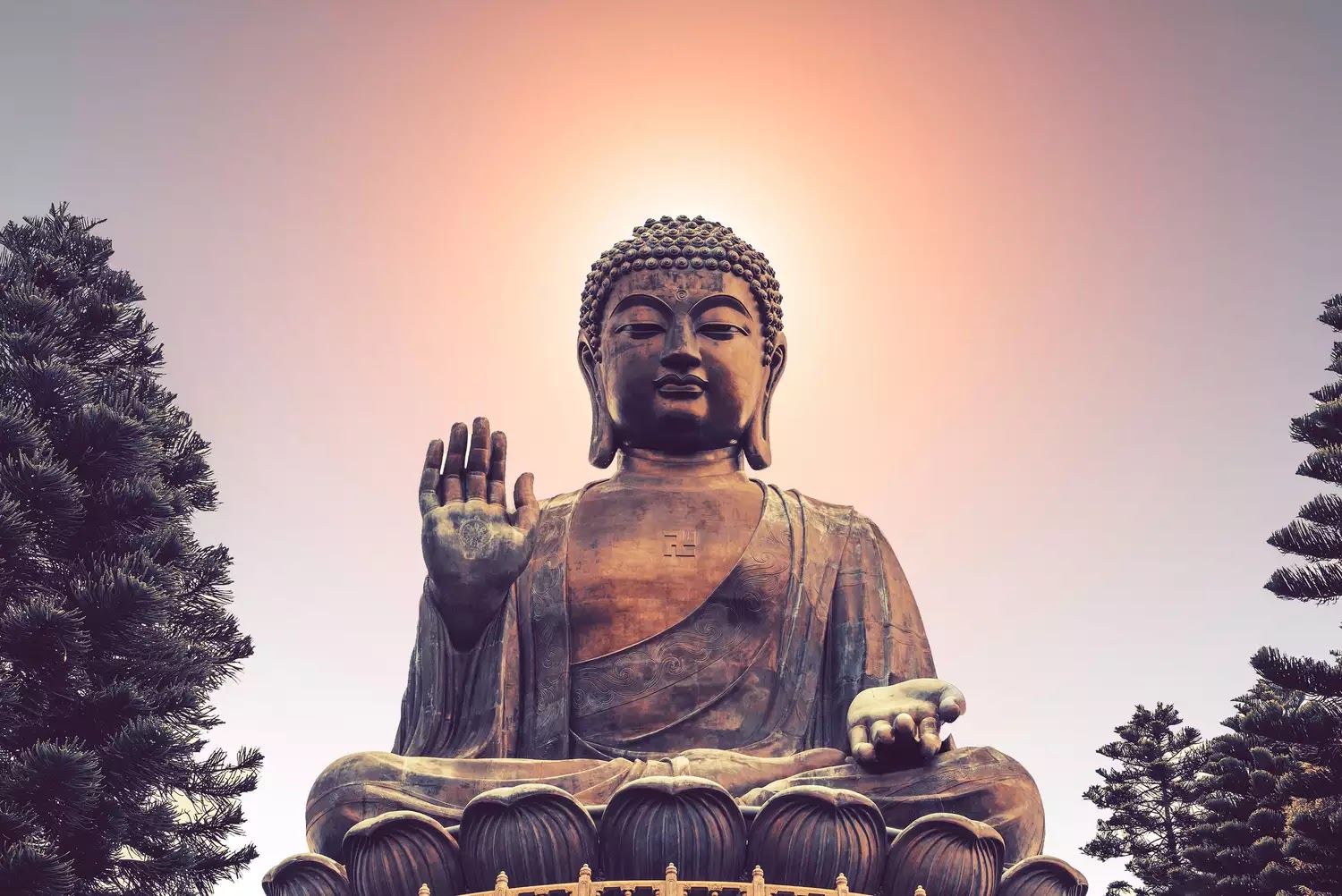
Slavoj Zizek, "Why Lacan is Not a Buddhist: A Belated Reply to My Critics"
Over the last decades, critiques of my reading of Buddhism have been abundant. Even those who are otherwise sympathetic to my general approach claim that I miss the point when I target Buddhism. Representative of my critics is “Nagarjuna and ecophilosophy” by Adrian J. Ivakhiv who also relies on John Clark’s “On Being None With Nature: Nagarjuna and the Ecology of Emptiness.” Ivakhiv’s starting point is the core Buddhist concept of “dependent origination”: every identity is process-relational position, which means that, say, a tree’s existence as a unitary object, as opposed to a collection of cells, is conventional: “Removing its properties leaves no core bearer behind.” In other words, “the thing we call a ‘tree’ is, as Buddhists say, empty of inherent self-existence; its essence is nothing other than the properties and conditions of its self-manifesting.”[1] This goes against Graham Harman’s (and others’) argument that there is something more to any object than its properties, relations, and conditions. For Buddhism, there is nothing (no-thing) left over. “But that is not to say that there is, in fact, nothing… There is the process-relational flux of what Clark calls ‘nature naturing,’ the continual coming into existence and passing away of the experiential bits of the world, all of which is quite real.”[2]
What the claim implies is that the “negative” and “deconstructive” project that Nagarjuna is best known for “goes hand in hand with an affirmative, ‘reality-based’ project of the sort that, in current continental philosophy, is best represented by Deleuze – or, to quote Clark:
“For Buddhism the negative path of the destruction of illusion is inseparably linked to the positive path of an open, awakened, and compassionate response to a living, non-objectifiable reality, the ‘nature that is no nature.’’’
And this brings us to what I see as the central challenge for Buddhism: how do we, humans, get caught in “a dream world of illusory, deceptively permanent objects and egos, and a futile quest to defend the ego and dominate reality”? Is it enough to say that this is a “fundamental human predicament,” i.e., a trans-historical invariant? Clark makes here a surprising move in a Marxist direction:
“Where most analyses (including most Buddhist analyses) of egocentric consciousness and the egoic flight from the trauma of lack stop short is in failing to investigate the social and historical roots of these phenomena. We must understand that the ego is not only a psychological and epistemological construct, but also a historical one. Its roots are to be found in the development of large-scale agrarian society and regimented labor, the rise of the state and ancient despotism, the emergence of economic class and acquisitive values, the triumph of patriarchy and warrior mentality – in short, in the evolution of the ancient system of social domination and the domination of nature. To put it in Buddhist terms, our true karmic burden, both personally and collectively, is our profound historicity and our deep materiality.”[3]
But the question remains: how far can we go in this direction of historicity? Were individuals in pre-class societies dwelling in a “living, non-objectifiable reality, the ‘nature that is no nature’”, and should the possible post-capitalist society also be conceived as a liberation from the “wheel of desire”? Another question lurks beneath this one: “Why should the destruction of illusion lead to compassion rather than to cynicism as it often seems to in everyday life, or to social conservatism as it has in the case of Humean and other forms of philosophical skepticism?”[4] I think that, in spite of all the desperate attempts to demonstrate that the way to Buddhist enlightenment passes through modesty and compassion, the only honest answer is that of D.T. Suzuki: Zen is a technique of meditation which is compatible with any political orientation: liberalism, fascism, Communism…
This brings us back to me and to the Buddhist critique of my work. For Ivakhiv, this is the point where Buddhism meets psychoanalysis: “The key difference between Freud/Lacan/Zizek/et al. and Nagarjuna is that the former presuppose that this /rise of dominating ego/ is unavoidable – the best we can do is to come to terms with the ego (etc.) process and try not to get too caught up in the delusional tricks it plays on us.”[5] This is why my work totally ignores “the real potential of actually reading Western Buddhism not just in light of Lacan, but the teachings of the Buddha and their lineage.”
The “real potential” is, of course, the affirmation of the flux of positive life, and Ivakhiv introduces it by way of a long quote from D.T. Suzuki:
“D.T. Suzuki, whom Zizek has probably never read,[6] a trained Zen Buddhist, as well as professor of Buddhist philosophy and delightfully fluent writer and speaker of English, echoes Vajjiya when he writes about Zen as life as ‘absolute affirmation’: ‘we live in affirmation and not in negation, for life is affirmation itself; and this affirmation must not be the one accompanied or conditioned by a negation, such an affirmation is relative and not at all absolute. With such an affirmation life loses its creative originality and turns into a mechanical process grinding forth nothing but soulless flesh and bones. To be free, life must be an absolute affirmation … Zen does not mean a mere escape from intellectual imprisonment, which sometimes ends in sheer wantonness. There is something in Zen that frees us from conditions and at the same time gives us a certain firm foothold … Zen abhors repetition or imitation of any kind, for it kills. For the same reason, Zen never explains but only affirms. Life is fact and no explanation is necessary or pertinent. To explain is to apologize and why should we apologize for living? To live – is that not enough? Let us then live, let us affirm. Herein lies Zen in all its purity and in all its nudity as well.’ (An Introduction to Zen Buddhism)”[7]
Ivakhiv’s “Lacanian” reading (supplemented by a critique of Lacan) is obvious here: far from advocating a renunciation of our desires, Buddha “is suggesting that staying true to our desire will yield the satisfaction of that (and all) desire, whereas Lacan is less interested in what it would mean to satisfy our desire, if it is once we have properly identified it.” How can this be? Ivakhiv introduces here sexual difference: he interprets (what Lacan calls) the impossibility of the sexual relationship as the impossibility to reach the goal of the masculine phallic subject which is to swallow/dominate the entire reality. From this phallic standpoint, Buddhism“appears as a fantasmic spectre in the West, where masculine jouissance is predominant. Buddhism at once promises and threatens with the Other, dark, feminine jouissance. Buddhism is only conceivable in what Zizek might call the Western ideological matrix as this testament to its very failure to be conceived. Zizek’s critique of Western Buddhism, therefore, has much less to do with the teachings of the Buddha than he has made it seem, and significantly more to do with the mystical, feminine jouissance it suggests, which seems to be beyond and for that reason threatening to Zizek.”[8]But is this equation of Buddhist enlightenment with the assertion of the mystical feminine jouissance not totally unfounded? Lorenzo Chiesa convincingly characterizes it as “an inverted mysticism”:
“Unlike Eastern polytheisms and their stress on enjoyment, Buddhism is thus in this sense a religion of desire, but it organises it in a way that is very different from that of Judeo-Christianity. More precisely, Buddhism short-circuits all the variations of desire (as poly-desire, we might add), which appear in it, in a most incarnate fashion, ‘with the ultimate apprehension of the radically illusory character of all desire.’”[9]
The formula of Buddhism would thus be: not the mystical “being one with the world” (my immersion into the divine One bringing full enjoyment) but “none with the world,” where I identify the void of my (in)existence, the nothingness of my Self, with the void of reality itself, which lacks any substantial (id)entity. While mysticism aims at the subject’s full immersion into divine jouissance, Buddhism focuses on desire as the ultimate cause of our suffering: desire is inconsistent and can never be fulfilled, fully satisfied, because its nature is inconsistent. Since its object is illusory, the false appearance of a void, the moment of desire’s fulfillment is the moment of its defeat. Buddhism draws the radical consequence from this insight: the only way to avoid suffering is to step out of (gain a distance towards) the “wheel of desire,” to avoid attachment to any object of desire, which means to accept (not only as a theoretical statement but also as an existential stance) that desires are illusory because all objects (of desire and in general) are non-substantial fluctuating appearances. Such an existential detachment is the only way for us to attain peace.
The key question that arises here is, of course: so, where does desire come from? How do we get caught in its illusion? Desire cannot be accounted for in the terms of the opposition between reified particular objects and the void beneath them, so that it arises when we get excessively attached to particular objects. The object-cause of desire (what Lacan calls objet a) is not an empirical object; it is a virtual element, which disturbs the harmonious natural circuit described and celebrated by my Buddhist critics. So, the vision, advocated by my critics, of a desire purified of its excess, is for Lacan totally illusory: desire is in itself a “pathological” excess, a de-stabilization of any balanced natural order. Suzuki seems to imply that what makes a desire mortifying is its “intellectualization,” its submission to rational categories that reify the fluid life experience of reality into a world of fixed substantial objects. However, desire is at its most basic not an effect of mechanic intellectual imprisonment; it is a “deviation” inscribed into life itself. In other words, if we subtract desire from life, we don’t get a more balanced life, but we lose life itself. To put it succinctly: Buddhism celebrates the stepping out of the “wheel of desire,” while Lacan celebrates the subject’s very fall into this “wheel”: “not compromising one’s desire” means a radical subjective engagement in a crazy desire which throws the entire reality out of balance.
Or, to put it in yet another way, while Buddhism accepts the common view that the purpose of life is happiness (to quote the Dalai Lama, “the purpose of our lives is to be happy”), it just defines this term differently. Here are a couple of statements by the Dalai Lama that make this difference clear: “Happiness is not something readymade. It comes from your own actions.” / “When we feel love and kindness toward others, it not only makes others feel loved and cared for, but it helps us also to develop inner happiness and peace.” / “We don’t need more money, we don’t need greater success or fame, we don’t need the perfect body or even the perfect mate. Right now, at this very moment, we have a mind, which is all the basic equipment we need to achieve complete happiness.” / “Human happiness and human satisfaction most ultimately come from within oneself.” Following Freud, Lacan, on the contrary, asserts death drive as the basic component of our libidinal lives that operate beyond the pleasure principle: what Lacan calls enjoyment (jouissance) emerges out of a self-sabotage of pleasure; it is an enjoyment in displeasure itself.
A Lacanian view is much closer to Dr. House who, in one of the episodes of the series, when he tries to diagnose a patient and one of his collaborators mentions that the patient radiates happiness, immediately adds “happiness” to the list of symptoms of the patient’s illness to be explained and abolished. The feeling of happiness is a dangerous symptom, not something we should strive for. And one should add here that the same goes for what is also considered the most spontaneous parental feeling: the immense love of one’s own small child. Small children are horror embodied: stupid, annoying, smelling bad, breaking our sleep… so the feeling of love for them is a clear case of what is called the „Stockholm syndrome,” a coping mechanism in a captive or abusive situation, when people develop positive feelings toward their captors or abusers over time. Isn’t this the exact mechanism of how we cope with small children?
So, what about the desperate Lacano-Buddhist attempt to read what Buddhism calls nirvana as basically the same stance as that signaled by Lacan’s “traversing the fantasy”? We cannot simply dismiss it as a gross misunderstanding of Lacan because there is a grain of truth in it: desire is metonymic – every empirical positive object that we desire is a trap in the sense that, if we get it, our desire is not fully satisfied but disappointed, we experience a “ce n‘est pas ca” (this is not that what we really desired). So, let’s drop our attachment to particular objects and just persist in surfing along from one object to another. In other words, a true betrayal of our desire is precisely our full attachment to a particular object as its true object: if we renounce this, if we maintain a distance towards every object, we attain peace, we are faithful to our desire, i.e., to the void in its heart which cannot be abolished by any object…
But this logic ultimately fails: for Lacan, desire in its “purity” (considered without an empirical object of desire) cannot be transformed into a peaceful integration into a non-substantial changing multiplicity of our reality because desire is as such a gesture of breaking up the balance of reality. If we subtract particular objects, we get the gesture of breaking-up, of disturbing the balance, as such. What any particular empirical object of desire obfuscates is not the balance of a void, but this negative gesture as such: any particular object particularizes this rupture as such, transforming it into a desire for something that positively exists as a particular object… But where is here the dimension of intersubjectivity?
In her “Relational Dharma,” Jeannine A. Davies deploys a “liberating model of intersubjectivity.” Her starting point is the basic goal of practicing dharma, which is
“to discern the distinction between conventional and ultimate realities through direct experience. A simple example of the distinction between conventional and ultimate reality is the difference between the concept of water and the physical sensation of water. Its salient characteristics are of wetness and of a cool, warm, or hot temperature. As awareness discriminates between the concept of water and water’s physical sensations, an insightful penetration into the nature of conceptual ideation occurs. Concepts are then seen as abstractions within consciousness, mental overlays born through prior conditioning.”
Davies, of course, has to concede that the practice of meditation is primarily focused on solitary, introspective methods, where stages of insight unfold within a climate of extreme mental seclusion and interpersonal isolation. Her aim is to demonstrate how dharma can also be achieved through a new practice of social interaction. In order to deploy this claim, she has to engage in the opposition between two main orientations of Buddhism, Mahayana and Theravada. Theravada concentrates on achieving dharma by means of individual practice of introspection, while Mahayana emphasizes dharma achieved by social interaction. Say, when an individual is afflicted by a trauma which threatens to destroy her/his psychic balance and ability to interact with others, Mahayana practices the Relational Dharma approach which
“mediates and attunes within an environment of empathic union, nourishing an atmosphere that assuages anxiety and facilitates the generation of trust and safety to flow in the in-between. This process allows for the possibility of transforming negative or life-diminishing ’filters’ into associations that widen and deepen identity. In this experience, the appearance of something ‘foreign,’ ‘not part of,’ or ‘too much,’ is relaxed, so that one’s sense of what constitutes a ‘whole person’ naturally broadens and evolves, and a deeper understanding of oneself and the relationship between oneself and others emerges.”[10]
In such an approach, one achieves “the inner liberty to feel another’s suffering as inseparable to one’s own and the compassion to seek to alleviate it, thus respecting the freedom of others as inseparable to one’s own freedom,” a freedom to “forgive others for their transgressions. In order to forgive, the ability to ‘step back’ and recognize the conditions that gave rise to his or her actions versus reacting from a place of personalizing these actions, must be developed. As awareness into the causal relationships that led this individual to be wounded and act in harmful ways becomes recognized, relational objectivity emerges and compassion becomes possible.”[11] Such a stance opens up a path to peacefully revolutionize our world beset by violence and non-sustainable action: our
“insight into the conscious engagement of interrelatedness may be one of the most important in terms of its spiritual, social, and political implications. It is only when we see with greater clarity the intimate causation of how ’we,’ citizens of the Whole, affect totality that we find the inspiration to take personal responsibility for our presence and fine tune our physiological, emotional, and physical resonance within the Whole.”[12]
Suffering and obstacles to freedom do not simply vanish, they are not simply left behind. In an almost Hegelian way, they are re-experienced as vehicles for growth and freedom. They are deprived of their substantial identity and put in their relational context, in which they arise and disappear in co-dependence, resonating within the Whole.
Another difference between Theravada and Mahayana concerns the accessibility of nirvana which makes the subject a bodhisattva. In Theravada, encountering somebody who already is a Buddha is needed to truly make someone a bodhisattva; any other resolution to attain Buddhahood may easily be forgotten or abandoned during the long time ahead. Theravada thus held that the bodhisattva path was only for a rare set of individuals and has to be transmitted through exclusive lineage, in contrast to Mahayanists who universalized the bodhisattvayana as a path, which is open to everyone and is taught for all beings to follow.
To maintain this universality, the Mahayana tradition has to introduce a distinction between two different notions of a bodhisattva’s relationship to nirvana. The basic goal is to become arhat (“the one who is worthy”), a perfected person, one who has gained insight into the true nature of existence and has achieved nirvana (spiritual enlightenment). The arhat, having freed himself from the bonds of desire, will not be reborn. While the state of an arhat is considered in the Theravada tradition to be the proper goal of a Buddhist, Mahayana adds to it a still higher level,
“a kind of non-dual state in which one is neither limited to samsara nor nirvana. A being who has reached this kind of nirvana is not restricted from manifesting in the samsaric realms, and yet they remain fully detached from the defilements found in these realms (and thus they can help others).”
We thus obtain the distinction between two kinds of nirvāṇa: the nirvāṇa of an arhat and a superior type of nirvāṇa called apratiṣṭhita (non-abiding) that allows a Buddha to remain engaged in samsaric realms without being affected by them. However, the predominant Mahayana notion of bodhisattva silently concedes that to arrive at such a non-dual state is practically impossible, so he heroically sacrifices his own dharma and postpones his awakening until all living beings are liberated. Bodhisattvas thus take the following vow: “I shall not enter into final nirvana before all beings have been liberated,” or “I must lead all beings to Liberation. I will stay here till the end, even for the sake of one living soul.”
The bodhisattva who wants to reach Buddhahood for the sake of all beings is more loving and compassionate than the sravaka (who only wishes to end their own suffering): he practices the path for the good of others (par-ārtha), while the sravakas do so for their own good (sv-ārtha). I find this distinction between par-ārtha and sv-ārtha potentially very dangerous: although Mahayana appears more “democratic,” allowing everyone to attain dharma, does its notion of bodhisattva who refuses to enter nirvana not conceal a new form of elitism? The select few who remain caught in our ordinary reality (in the wheel of desire), legitimize their special privileged position by the fact that they could have reached nirvana but postponed it to help all others to reach it. In some radical sense nirvana thus becomes impossible: if I reach it, I act as an egoist, caring only for my own good; if I act for the good of others, I postpone my entry into nirvana…
I consider this privileged position dangerous because it remains caught in a dualism that authentic Buddhism promises to leave behind: the realm of nirvana becomes a Beyond which we strive to reach. The danger resides in the fact that this position relies on what one could call the basic syllogism of self-sacrifice: I want all living beings to overcome their suffering and achieve the supreme good; to do this, I have to sacrifice my own happiness and accept suffering – only in this way my own life has meaning. Again, the danger is that a short-circuit necessarily occurs here: I automatically take my own suffering as a proof that I am working for the good of others, so that I can reply to anyone who criticizes me: “Can’t you see my suffering? Who are you to criticize me when I sacrifice myself for you?” This is why the only authentic nirvana means that I fully remain in this world and just relate to it differently: “non-abiding” nirvana is the ONLY full and true nirvana. So, where does even this authentic nirvana fail?
Buddhism ignores the radical intersubjectivity of desire, the fact that desire is always reflexive (a desire for desire, a desire for being desired), and that the primordial lacking object of desire is myself, the enigma of what I am for my others. What this means is that, as Hegel clearly saw it, domination of others and violence towards them is a key moment of the painful process of intersubjective recognition. This violence is not an expression of my egotistic self-interest; it relies on an “evil,” for which I am ready to put my own welfare and even my life at risk. Relational dharma is not enough to account for this “evil” since this dimension of “evil” is constitutive of how I experience an Other: as an impenetrable abyss, which cannot be dissolved in a fluid network of appearances. At is most basic, “evil” has nothing to do with my egotist interests: it is more spiritual than simple self-interest. The Buddhist notion of samsara (“the wheel of desire”) ignores this spiritual aspect of “evil.”
This is where the already-quoted passage about the “key difference between Freud/ Lacan/ Zizek/ et al. and Nagarjuna” – “the former presuppose that this /rise of dominating ego/ is unavoidable; the best we can do is to come to terms with the ego (etc.) process and try not to get too caught up in the delusional tricks it plays on us”[13] – totally misses the point. Buddhism describes how we can gradually get rid of the egotistic stance of domination over others and of being enslaved to our desires that both cause suffering; our goal is to reach dharma, in which our ego dissolves in the flux of appearances and loses its substantial identity. Within this space, Freud and Lacan can only appear as going halfway: they clearly see the self-destructive nature of the dominating ego, but they ignore that there is a domain beyond the ego and its paradoxes, the domain of inner peace and happiness, so their ultimate reach is to describe the paradoxes of the ego. For Freud and Lacan, on the contrary, there is nothing beyond the antagonisms of our reality, nothing but the gap of impossibility that thwarts it from within: everything that we perceive as its Beyond, we project there. What this means is not that what Buddhists describe as nirvana or dharma is an illusion or fake: it is a profound experience of subjective destitution, but it nonetheless functions as the obfuscation of a more radical experience of a gap out of which our reality appears.
Since dharma is, as a rule, described as the highest freedom accessible to us, one should point out that, to anyone who knows a little bit about Hegel, the radical opposition between the Buddhist and Hegel’s notion of freedom cannot but strike the eye. For Buddhism, we are truly free when we liberate ourselves from the rational categories that cut into pieces and thus mortify the pure non-substantial flux of reality, while for Hegel, the basic form of freedom is precisely the infinite power of abstraction that pertains to our Understanding (not Reason), the power to interrupt the smooth flow of reality and to cut mechanically reality into its species. The very idea that there is something (the core of the substantial content of the analyzed thing) which eludes Understanding, a trans-rational Beyond out of reach, is the fundamental illusion of Understanding. In other words, all we have to do to get from Understanding to Reason is to subtract from Understanding its constitutive illusion! Understanding is not too abstract/violent; it is, on the contrary, as Hegel put it apropos of Kant, too soft towards things, afraid to locate its violent movement of tearing things apart in the things themselves. In a way, it is epistemology versus ontology: the illusion of Understanding is that its own analytic power – the power to make “an accident as such – that what is bound and held by something else and actual only by being connected with it – obtain an existence all its own, gain freedom and independence on its own account” – is only an “abstraction,” something external to “true reality” which persists out there intact in its inaccessible fullness. In other words, it is the standard critical view of Understanding and its power of abstraction (that it is just an impotent intellectual exercise missing the wealth of reality) that contains the core illusion of Understanding. To put it in yet another way, the mistake of Understanding is to perceive its own negative activity (of separating, tearing things apart) only in its negative aspect, ignoring its “positive” (productive) aspect: Reason is Understanding itself in its productive aspect.
The common counter-argument is here: but is for Hegel such a mortifying abstraction not just a negative moment followed by a notional mediation, by means of which we return to a higher form of organic unity? Yes, but this higher organic unity in no way returns to the reality of direct experience: in it, any reference to direct experience is obliterated, we move entirely within notional self-mediation. This doesn’t mean that Hegel does not allow for something that echoes the practice of meditation which (within Theravada Buddhism) “has primarily focused on solitary, introspective methods, where stages of insight unfold within a climate of extreme mental seclusion and interpersonal isolation.” However, while, in Buddhism, through such practice, the mind “experiences a kind of current of quiet peace,” for Hegel, introspection confronts us with an awful space, in which ghastly apparitions of partial objects float around. Here is his most famous and often quoted passage of this “night of the world”:
“The human being is this night, this empty nothing that contains everything in its simplicity – an unending wealth of many representations, images, of which none belongs to him – or which are not present. This night, the interior of nature, that exists here – pure self – in phantasmagorical representations, is night all around it, in which here shoots a bloody head – there another white ghastly apparition, suddenly here before it, and just so disappears. One catches sight of this night when one looks human beings in the eye – into a night that becomes awful.”[14]
One should not be blinded by the poetic power of this description, but read it precisely. The first thing to note is how the objects that freely float around in this “night of the world” are membra disjecta, partial objects, objects detached from their organic Whole. Is there not a strange echo between this passage and Hegel’s description of the negative power of Understanding, which is able to abstract an entity (a process, a property) from its substantial context and treat it as if it has an existence of its own? “That an accident as such, detached from what circumscribes it, what is bound and is actual only in its context with others, should attain an existence of its own and a separate freedom—this is the tremendous power of the negative.”[15] It is thus as if, in the ghastly scenery of the “night of the world,” we encounter something like the power of Understanding in its natural state, spirit in the guise of a proto-spirit. This, perhaps, is the most precise definition of horror: when a higher state of development violently inscribes itself in the lower state, in its ground/presupposition, where it cannot but appear as a monstrous mess, a disintegration of order, a terrifying unnatural combination of natural elements. And Hegel’s ultimate lesson is to learn to “tarry with the negative,” not to dissolve its unbearable tensions into any kind of natural positive flux of appearances.
Notes:
[1] Ivakhiv, op.cit.[2] Op.cit.[3] Clark, op.cit., p. 28.[4] Ivakhiv, op.cit[5] Op.cit.[6] Incidentally, I DID read Suzuki, not only in my youth (when he was a key point of reference of the hippie movement) but also later, when I learned that, in the 1930s and early 40s, he fully supported the Japanese war against China and elaborated how Zen training can make individuals much better soldiers.[7] Ivakhiv, op.cit.[8] Op.cit.[9] Lorenzo Chiesa and Adrian Johnston, God Is Undead: Psychoanalysis Between Agnosticism and Atheism, manuscript (to appear at Evanston: Northwestern University Press in 2023). Quotes within the quote are from The Seminar of Jacques Lacan. Book X: Anxiety, Cambridge: Polity Press 2016, p. 226.[10] Op.cit.[11] Op.cit.[12] Op.cit.[13] Ivakhiv, op.cit.[14] G. W. F. Hegel, “Jenaer Realphilosophie,” in Frühe politische Systeme, Frankfurt: Ullstein 1974, p. 204; translation quoted from Donald Phillip Verene, Hegel’s Recollection, Albany: Suny Press 1985, pp. 7–8.
[15] G.W.F. Hegel, Phenomenology of Spirit, Oxford: Oxford University Press 1977, p. 19.
Subscribe to:
Posts (Atom)