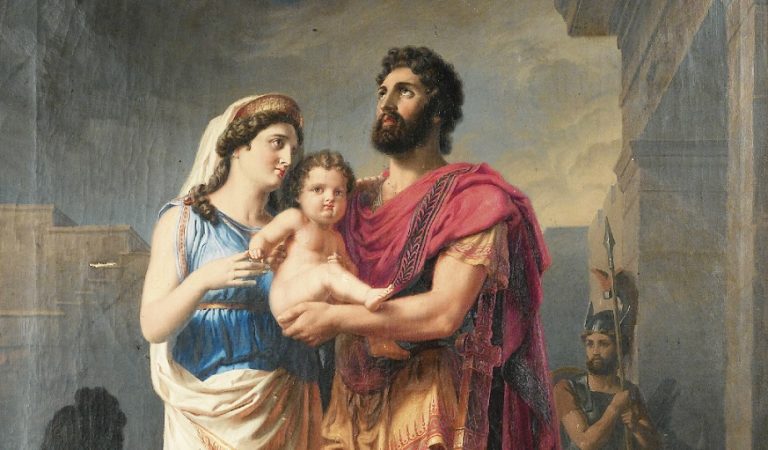
Friedrich Schiller, "Hector and Andromache"
Andromache
Will you, my Hector, forever go away
to where with unmatched hands Achilles makes
Patroclus bloody off’rings?
____________________Who will teach
your little one with strength to throw the spear,
or how to honor the gods, if what I fear
occurs and Orcus devours you?
Hector
Dear wife, enough of tears, for go I must,
for love of you I burn with battle-lust
my arms sustain Pergamus.
____________________If now I fall,
I’ll fall in the Trojan gods’ and your defense
as a pious hero, then make my descent
to grim, to Stygian Dis.
Andromache
I’ll never hear the clash of your weapons again,
unused, your iron will rust in the halls of men,
and Priam’s line will die.
__________________You’ll go to where
no sun, no day e’er shines his golden face,
to where the Cocytus slithers through the waste,
your love will die in the Lethe.
Hector
Though all my hopes and all my thoughts will sink,
from the gentle flow of the Lethe, my love won’t drink,
no, my love won’t drink.
__________________Listen! The Greeks
are blustering at Ilium’s walls. Now gird my sword,
hold back your tears, and listen to my word;
My love won’t die in the Lethe.
...and the Return to Ithaca of Odysseus
The Cretin Lie But a spirit in me urged, 'Set sail for Egypt—- Homer, "Odyssey" (Book XIV)
fit out ships, take crews of seasoned heroes!' Nine I fitted out, the men joined up at once
and then six days my shipmates feasted well
But swept away by their own reckless fury, the crew went berserk—
they promptly began to plunder the lush Egyptian farms, dragged off the women and children, killed the men.
Outcries reached the city in no time—stirred by shouts

from Google AI:
Odysseus tells the famous "Cretan Lie" (most notably to the loyal swineherd Eumaeus) primarily to conceal his true identity, test the loyalty of his listener, and gauge the political climate in Ithaca before revealing himself to launch his attack on the suitors.
The intricate, multi-layered fabricated tale serves several specific purposes:
The episode highlights Odysseus's signature trait of metis (cunning intelligence), proving that verbal deception is just as vital to his survival as physical strength
- Testing Loyalty and Eliciting Empathy: By arriving as a disguised beggar who claims to be a Cretan exile who fought at Troy, Odysseus tests Eumaeus’s trustworthiness and hospitality. The tragic backstory allows him to see if the swineherd will treat him with kindness or try to exploit him.
- Gathering Intelligence: The lie is cleverly designed to sound plausible and provoke the listener into sharing valuable local news. It tricks Eumaeus and others into revealing current information about the suitors, the state of Odysseus's family, and who is still loyal in Ithaca.
- Strategic Veil of Secrecy: Odysseus knows he cannot take on the suitors alone without a strategic advantage. By passing as a wandering outsider, he avoids raising alarm or prematurely tipping his hand.
- Cultural and Historical Context: The lies establish him within a recognizable tradition of other Cretan heroes, allowing him to blend in perfectly as a seasoned veteran and mariner.

15 comments:
Yawn
There's no odissean-wise on the West today.
Sigh.
Only Pennywises...
,,,and Pounds***ters.
You must mean that the West is FULL of Cretans! On THAT, we can agree.
Indoctrinated into cretinity?
Tout to bent knees before false gawds?
Infested with learned helplessness?
Fooled???
Foxes vs Lions... surplus elites in competition for limited power.
I am most definitely a fool...
...most foolish thing to say. Yawn.
"I know only that that I know nothing"(c)
Remember?
Or like Xian would say -- you are drowning in sin of Pride(unbeatable, yeah)
Or Booo-ist -- you departed from Golden middle path ;-p
Just generational. Sons against farthers (or... sons against mothers ;-p)
I'm certainly not a king (ala Parsifal and the Fisher King). Doesn't that make me a fool? Searching for the Holy Grail to save/ rejuvenate a kingdom not my own?
Lacan, desire = che voui? "Man's Desire is the desire of the other"
I search for the answer to your question.
Why?
No, its quantity, not quality. Generations grow in size (until recently at least). Elite positions (hierarchical) grow ever smaller the higher you go. And what does every candidate for an elite position desire? A feeling of increased (not decreased) power, of course (Nietzsche).
Surplus elites in competition for power.
To not rise as high in the social hierarchy and do at least as well as your parents... is a disgrace, no?
How could Telemachus ever hope to match the accomplishments of his father, let alone surpass him?
The Bridge: "Man is a rope, tied between beast and Überman—a rope over an abyss. ... Man is something that hath to be surpassed."
Constant Becoming: "Man must surpass himself; he is a bridge, not an end."
The Ideal: "He who attains his ideal, precisely thereby surpasses it."
Desiring what the other wants... Mimetic desire creates the competition game, creating scapegoats and expelling (or killing) them. Establishing a friend-enemy distinction (Carl Schmitt)
1. The "Friend-Enemy" Distinction
Schmitt famously argued in The Concept of the Political (1932) that every political action can ultimately be reduced to the fundamental distinction between friend and enemy. He believed that politics is inherently defined by the potential for existential, mortal conflict between distinct groups. For Schmitt, the "enemy" is not a personal or economic rival, but a public "other" that poses a threat to a community's distinct way of life.
Post a Comment